Protocol Designs for Real-Time Eligibility Verification Across Distributed Gaming Networks
Olivia Baumann · Jul 11, 2026

Protocol Designs for Real-Time Eligibility Verification Across Distributed Gaming Networks
Distributed gaming networks rely on sophisticated protocol designs to handle eligibility verification in real time, and these systems process thousands of simultaneous checks across multiple servers and regions. Engineers build these protocols around consensus mechanisms that confirm user status, entry validity, and prize qualifications without introducing noticeable delays, while data synchronization occurs through layered authentication steps that draw from central databases and edge caches alike.
Core Elements in Protocol Architecture
Protocol stacks typically incorporate message queuing systems paired with cryptographic hashing to maintain integrity across nodes, and developers often integrate timestamp synchronization using protocols such as NTP variants adapted for gaming environments. These designs allow eligibility data to propagate quickly, whereas regional variations in rules get flagged through metadata tags that travel alongside each verification request. Researchers have documented how such architectures scale when participant numbers surge during peak hours, and evidence from industry reports shows reduced error rates when protocols employ hybrid models combining centralized oversight with decentralized validation layers.
Handling Time-Sensitive Checks
Real-time requirements demand low-latency pathways, so protocols frequently use event-driven triggers that activate verification upon entry submission, and these triggers connect to distributed ledgers where eligibility records update continuously. As of July 2026, several platforms have adopted enhanced versions that incorporate predictive caching based on historical patterns, which cuts down on round-trip times while preserving accuracy across time zones. Observers note that when networks span continents, protocols must account for clock skew and jurisdictional differences through adaptive rule engines that adjust thresholds dynamically.
Security and Data Flow Considerations
Security protocols embed multi-factor checks that verify identity tokens against stored profiles, and they route suspicious activity through secondary review queues without halting the main verification stream. Data flows follow defined schemas where eligibility attributes transmit in encrypted packets, whereas audit logs capture every decision point for later compliance reviews. Studies from academic institutions highlight how these measures prevent unauthorized alterations, and figures from the Australian Communications and Media Authority reveal consistent improvements in detection rates when protocols include anomaly detection modules trained on live traffic data.
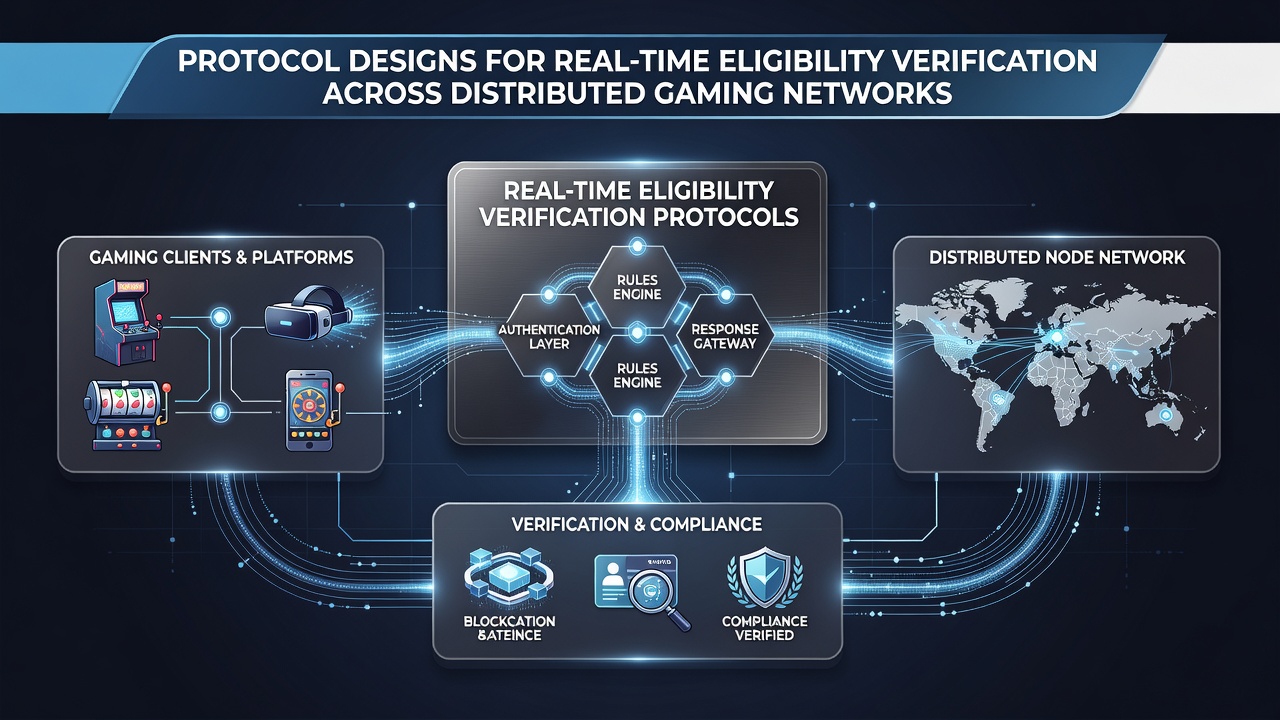
Interoperability standards play a central role because gaming networks often integrate third-party services for payment processing and user management, so protocols define clear API endpoints that standardize requests and responses. Engineers test these interfaces under simulated load conditions to ensure they withstand concurrent verifications, and results indicate stable performance when redundancy protocols activate during partial outages. What's interesting is how modular designs allow individual components to update independently without disrupting the entire network.
Scalability Approaches Across Regions
Geographic distribution introduces challenges related to varying regulations, and protocol designers address them by embedding configurable policy modules that load region-specific rules at runtime. Canadian regulatory data from the Canadian Regulatory Gaming Consortium shows that networks using such flexible frameworks achieve higher compliance scores during cross-border events. Load balancing algorithms distribute verification tasks across available nodes based on current capacity, while failover mechanisms reroute traffic instantly when primary paths experience congestion.
Future Protocol Enhancements
Emerging designs explore integration with machine learning models that predict eligibility outcomes from partial data sets, and these models run alongside traditional rule-based systems to flag edge cases for human review. Testing in controlled environments has demonstrated faster resolution times for complex queries, and ongoing refinements focus on minimizing false positives through iterative training cycles. Those who've studied these systems know that balancing speed with precision remains a constant engineering priority.
Conclusion
Protocol designs for real-time eligibility verification continue to evolve alongside advances in distributed computing and regulatory frameworks, and the combination of cryptographic security, adaptive synchronization, and modular policy handling supports reliable operation across expansive gaming networks. Implementation details vary by platform scale, yet core principles of low-latency consensus and secure data exchange remain consistent throughout the field.